Monday, August 14, 2006

Human Towers - Spain and India.


Castellers

In the region of Catalonia teams of Castellers can be seen competing against each other who can build the highest human tower. Every Catalan town has their own team or Colla made up of men, woman and children. This unique spectacle can be seen during the summer months in festivals around Catalonia. Taking directions from a Cap de colla the Castellers form a solid foundation of packed bodies, linking arms and hands together in an intricate way that will carry the weight of several tones. The foundation also serves to soften the fall in case the tower collapses, which is not uncommon. On this foundation up to eight more levels of people are built, each layer standing on the shoulders of the ones below. The top levels are made up of children and the Castell is completed when a young child waves to the crowd from the top of the pinnacle.


Dahi Handi

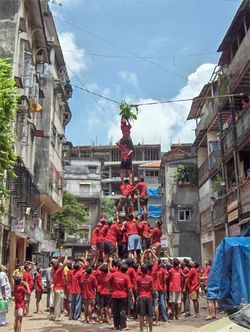
generally takes place on the second day of Janmashtami which falls on the eighth day of Sravana. An earthen pot containing a mixture of milk, dry fruits, ghee is hung around 20-30 feet high in the air with the help of a rope. Silver coins are hung along with the rope,which are later distributed as prize to the winners. Enthusiastic young men, form a human pyramid by standing one on top of the other, trying to break the pot. Onlookers throw water on the young men in order to prevent them from breaking the pot. Breaking of the pot is followed by prize distribution. Devotees believe that the broken pieces of earthen pot will keep away mice and negative powers from their homes.
Sunday, August 13, 2006

Water Festival Thailand and Holi Festival India.

Songkran

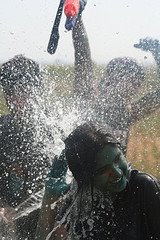
is a Thai traditional New Year which starts on April 13 every year and lasts for 3 days. Songkran festival on April 13 is Maha Songkran Day or the day to mark the end of the old year, Songkran is a Thai word which means "move" or "change place" as it is the day when the sun changes its position in the zodiac. It is also known as the "Water Festival" as people believe that water will wash away bad luck.

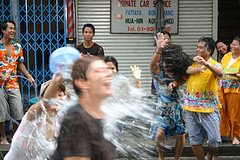
The Songkran tradition is recognized as a valuable custom for the Thai community, society and religions. The value for family is to provide the opportunity for family members to gather in order to express their respects to the elders by pouring scented water onto the hands of their parents and grandparents and to present them gifts including making merits to dedicate the result to their ancestors. The elders in return wish the youngsters good luck and prosperity. In the afternoon, after performing a bathing rite for Buddha images and the monks, the celebrants both young and old, joyfully splash water oon each other.


Rangpanchami India.

One of the major festivals of India, Holi is celebrated with enthusiasm and gaiety on the full moon day in the month of Phalgun which is the month of March as per the Gregorian calendar. Great excitement can be seen in people on the next day when it is actually the time for the play of colours. Shops and offices remain closed for the day and people get all the time to get crazy and whacky. Bright colours of gulal and abeer fill the air and people take turns in pouring colour water over each other. Children take special delight in spraying colours on one another with their pichkaris and throwing water balloons and passers by. Women and senior citizen form groups called tolis and move in colonies - applying colours and exchanging greetings. Songs, dance on the rhythm of dholak and mouthwatering Holi delicacies are the other highlights of the day.


Both these festivals take place at approximately the same time in March-April every year and are celebrated by throwing colored water over family and friends.

Introduction

Introduction to similar cultural Practices.


This blog will record similar cultural practices all over this diverse world of ours. In doing so it hopes to promote international understanding and cooperation overcome prejudice and end racism and bigotism.

Interculturalism

is the philosophy of exchanges between cultural groups within a society.

Various states have intercultural policies which seek to encourage the socialization of citizens of different origins. These policies are often used as an instrument to fight racism, overcome prejudice and misunderstanding of others.

Interculturalism requires an inherent openness to be exposed to the culture of the "other". Once a person is exposed to an element of a different culture, a dialogue will ensue, where everyone embarks upon understanding the culture of the other, and usually this involves comparisons. Thus, interculturalism breeds dialogue, in order to be able to look for commonalities between that element of one's culture and the culture of the other.

Interculturalism seeks to enhance fusion by looking for commonalities. Hence, a new world culture is constructed based on the fusion of all commonalities of cultures. The differences that remain make up the subcultures of the world.